President Ruto has assured Ugandan that Kenya will begin extending the SGR from Naivasha to Kampala in early 2026, under a joint Kenya–Uganda initiative.
He said the extension will link up with the planned Malaba–Kampala line, deepening rail connectivity between the two countries.
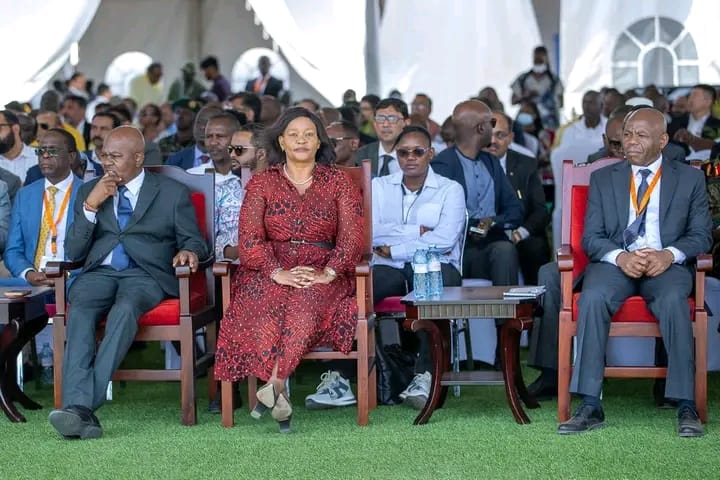
President Ruto made the pledge during the groundbreaking of the Devki Mega Steel Project in Osukuru, Tororo District.
The delegation was hosted by Ugandan President Yoweri Kaguta Museveni in what marks one of East Africa’s most strategic industrial milestones this year.
The multi-billion-shilling steel plant, set to occupy more than 400 acres, is expected to significantly transform the region’s steel production capacity.
Once operational, the plant will drastically cut import bills, create thousands of jobs, stimulate new value chains, and unlock broader economic opportunities for both Kenya and Uganda.
During the ceremony, Presidents Ruto and Museveni reaffirmed their commitment to promoting large-scale cross-border investments that support Africa’s industrialisation agenda.
They emphasised the importance of deepening cooperation to boost intra-African trade, strengthen regional value chains, and drive sustainable development.
Kenya Railways Managing Director Philip Mainga was among the senior government officials who accompanied President William Ruto to Uganda for
Mainga’s presence was particularly significant in light of Kenya’s renewed focus on expanding regional rail infrastructure — especially the Standard Gauge Railway (SGR) corridor.
The SGR project is part of the Northern Corridor Integration Projects (NCIP), a regional framework involving Kenya, Uganda, Rwanda, and South Sudan.
Kenya has already completed the Nairobi–Naivasha section of the line. Plans remain active to extend the railway further to Kisumu, Malaba, Kampala, and eventually to Kigali.
Uganda has recently revived procurement and financing for the Malaba–Kampala leg, signalling renewed momentum.
Meanwhile, Rwanda continues to back the Kampala–Kigali segment, viewing it as a cornerstone for cost-effective regional trade.
Key benefits include:
Reduced transit time: Cargo travel from Mombasa to Kigali could drop from several days by road to under 24 hours.
Lower freight costs: More efficient rail transport will make regional exports and imports more competitive.
Stronger trade integration: Bulk commodities like steel, cement, fuel, and agriculture products will benefit significantly.
Industrial support: Factories like the Devki Mega Steel Plant will rely on the SGR for efficient movement of raw materials and finished goods.
President Ruto’s commitment to the Naivasha–Kampala extension underscores how closely Kenya is tying its industrial ambitions to rail infrastructure.
By ensuring the SGR reaches Kampala, Kenya and Uganda are laying the groundwork for tighter economic integration — not just for steel, but across many sectors.
For Kenya Railways, the involvement of Philip Mainga at the Devki groundbreaking sends a strong signal: transport and industry are being developed hand in hand, and the SGR is central to that vision.