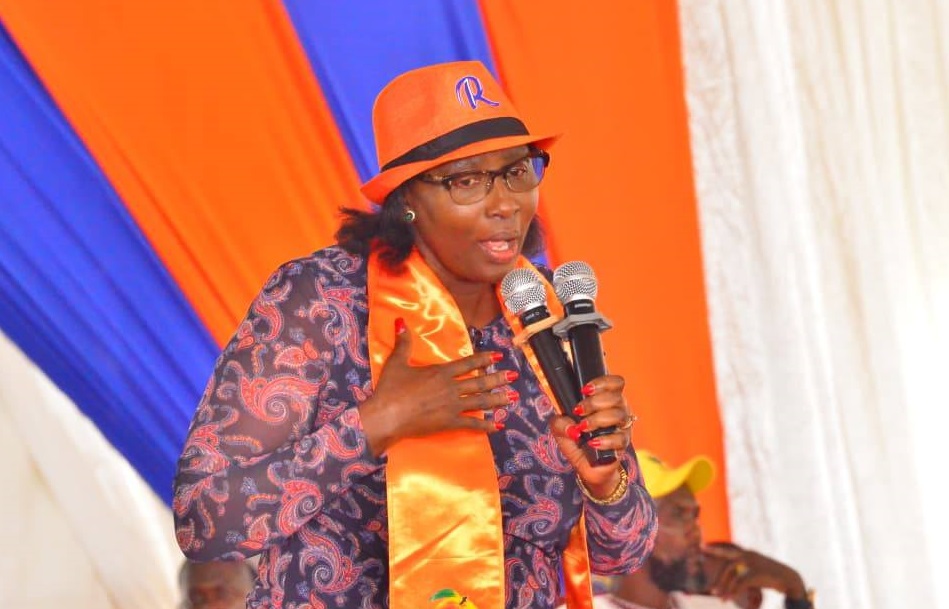
Dagoretti North MP Beatrice Elachi on Friday mounted a robust defense of the Orange Democratic Movement (ODM) and its participation in the Broad-Based Government arrangement, framing the decision as a calculated move designed to preserve the party’s national relevance and regional strength.
Addressing senior citizens and community opinion leaders in Ruaraka Constituency, Elachi fused grassroots engagement with high-level political messaging, repeatedly emphasizing that “wisdom is power” in navigating Kenya’s shifting political terrain.
“Not a Party for Family”
In what appeared to be a pointed response to internal murmurs within the party, Elachi underscored that ODM is not a preserve of any family or inner circle but a national movement built on ideology.
“Let me now tell everyone, even the family, this is not a party for family… this is not a party for family but for everyone who believed in Raila’s ideology,” she said.
Her remarks signaled a call for discipline and inclusivity within ODM ranks, urging members to safeguard the party’s identity as a broad-based political vehicle rather than a personalized outfit.
Political analysts view such messaging as an attempt to consolidate unity amid evolving alliances and shifting political alignments.
Strategic Case for the Broad-Based Government
A central theme of Elachi’s address was the defense of ODM’s decision to participate in the Broad-Based Government — a move that has drawn mixed reactions within sections of the party’s support base.
She credited party leader Raila Odinga with foresight in ensuring ODM remained embedded within the governance structure during a period of national transition.
“If Baba had left us outside, regions would have already left ODM,” she stated.
According to Elachi, remaining within the arrangement ensured continued national visibility, safeguarded regional support blocs, and maintained ODM’s strategic positioning in national politics.
She characterized the move not as compromise but as political prudence, arguing that exclusion from governance would have weakened the party’s influence across the country.
Praise for Raila’s Leadership
Throughout the speech, Elachi repeatedly invoked what she termed Raila’s “wisdom” in steering the party through complex political transitions.
“Raila alikuwa na wisdom ya kuwacha ODM ndani ya Broad-Based Government.”
She described him as a seasoned statesman capable of recalibrating strategy without abandoning ideological foundations — a narrative aimed at reinforcing confidence among party faithful.
Revisiting Political History
Elachi also referenced the historical political journey between President William Samoei Ruto and Raila Odinga, reminding the audience that Kenya’s political landscape has long been defined by shifting alliances.
She noted that Ruto once stood alongside Raila, an alliance that culminated in Raila’s tenure as Prime Minister following the 2008 Grand Coalition Government.
Her remarks appeared designed to contextualize current political alignments within Kenya’s broader history of coalition-building and negotiated governance.
Biblical Undertones and Message of Gratitude
In a departure from strictly political analysis, Elachi invoked scripture to underscore the importance of gratitude and loyalty in leadership.
“Kusema Asante kuna njia mingi…” (There are many ways of saying thank you.)
She contrasted appreciation with moments in which, she suggested, some former allies distanced themselves from Raila during politically difficult periods.
The biblical reference reinforced her overarching message: political leadership must be anchored in moral grounding, loyalty, and strategic patience.